

Somebody Help Me, I've Paid for the Same Wrong Answer Twice
The lie and the correction, full price for both. Three days of arguing with myself about whether that's a scandal.

On Tuesday night, at roughly the hour when the smoke alarm likes to chirp for no reason, I asked an AI to check a date for me. A small thing. One date, for one paragraph, in one chapter. It answered instantly, confidently, beautifully... and wrongly. So I told it so, and it apologised with the lavish sincerity of a hotel manager who has just found a stranger's sock in your bed, and it generated a new answer, and somewhere in a data centre a little meter went tick tick tick, and I paid for both. The lie and the correction. Full price, twice.
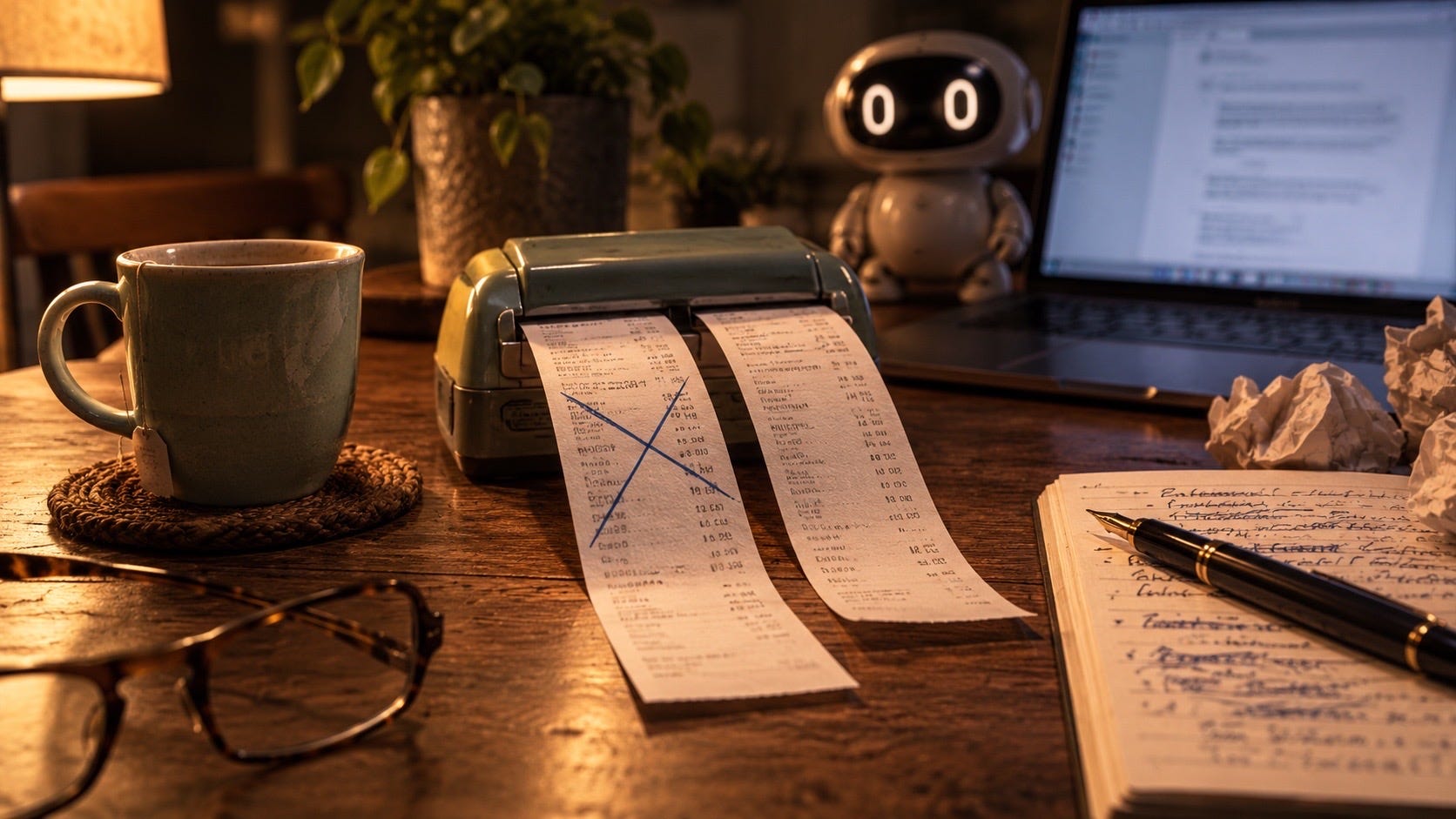
And I sat there in the dark with my tea going cold thinking, hang on. Hang on just one minute, Otto. (All AI models are called Otto now. I've decided. It helps.)
Because here is the thing that got under my skin like a splinter from a cheap braai bench: no other business on this entire spinning planet gets to run this racket. If the waiter brings you the wrong meal, the wrong meal goes back and the right one arrives and you pay once. If your mechanic fits the wrong part, he does not present you with an invoice titled Parts, Incorrect followed by a second one titled Parts, Correct This Time, Sorry Hey. My mechanic in Cape Town once refused payment entirely because the rattle came back within the week. Ask my mom. She was in the car.
But Otto? Otto gets it wrong, and Otto’s boss sends me a bill for eleventy hundred thousand tokens, and everybody carries on as if this is a normal way to sell things.
So the argument writes itself, surely. Refund the tokens. Wrong answer, money back. Simple as a Sunday.
Except.
Except I have now spent three days arguing with myself about this, out loud, in the kitchen, to the visible concern of my children, and I regret to inform you that the other side has a point, and I hate it here.
Because the moment you promise a refund for "wrong," you have to define "wrong," and whooo boy. Wrong according to whom? Half the time the machine is wrong because I asked a question with the clarity of a voice note recorded inside a washing machine. If I ask a human friend "what was that thing, you know, from the thing" and she guesses incorrectly, she does not owe me money. She owes me nothing. She was doing her best with the rubbish I gave her. And the other half of the time, "wrong" means "not what I wanted to hear," which is a different product entirely, and one my own mother has never once refunded me for either.
And then there's the fraud problem, which is not a maybe but a certainty, because I know people, I have met them. The second wrongness pays out, every answer in the world becomes wrong. Gary Refundberg logs on at dawn, declares that all fourteen thousand of his answers were disappointing, and retires to a yacht. You would need a second AI to judge whether the first AI erred, and then presumably a third to judge the second, and eventually it's Ottos all the way down, each one apologising to the one above it, none of them paying for anything.
But I digress. Let me reverse this ship back into the harbour.
Here's what I concluded , somewhere around day two, standing in front of the open fridge for reasons I could not explain even to the fridge. The refund question isn't really about money. It's about who carries the risk of a machine that is brilliant and unreliable in the same breath, and right now the answer is: me. You. The person at the bottom, holding the receipt. The companies took the telecoms billing model, the one where you pay for minutes whether the call was worth making or not, and bolted it onto a product we judge like we judge an employee: on outcomes. And when the outcome is garbage, the meter does not care. The meter has never cared about anything. The meter is the most honest one in the whole arrangement.
And what nobody says enough is that the wrongness is profitable.
Three attempts bill more than one. A machine that nails it first time is, in the strict accounting sense, a worse business than a charming one that needs a do-over. Which means the incentive to fix the confident nonsense is... let's say gentle. It's the only industry where the defect comes with a tip jar.
So no, I don't exactly think Otto should refund my tokens, because I've seen what humans do with a loophole and it isn't pretty. But I think the pressure behind the demand is dead right and shouldn't be laughed out of the room. Somewhere between "pay for every mistake, sucker" and "free money for Gary" there's a grown-up answer... pay-per-outcome for the things a machine can actually verify, code that runs, a citation that exists, a date that checks out, and honest metered pricing for the foggy rest, priced like the gamble it is. The technology grew up. The till slip didn't.
Anyway. On Tuesday night I got my corrected date, finally, third attempt, and it was right, and I checked it myself against an actual source like a medieval scribe, and I put it in the chapter, and I paid for all three rounds without complaint because what exactly was I going to do, phone someone? There's no someone. There's just the meter, ticking away in the dark like Pink Floyd's Time, all those clocks going off at once and nobody responsible for any of them.
I finished my cold tea and I did not ask Otto anything else.
Small victories. I'm charging myself one token for this ending, and honestly, I'd like it back.